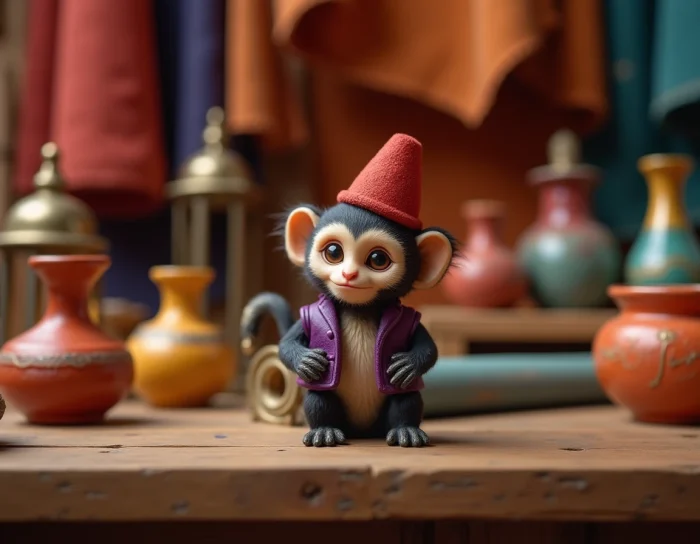
Abu is not just a simple travel companion. The little capuchin monkey from the film Aladdin, released in 1992, carries part of the narrative on his shoulders: he triggers plot twists, expresses what Aladdin cannot say, and serves as comic relief in the tensest moments. His role goes beyond that of the animal sidekick that Disney typically placed alongside its heroes.
Abu in the Cave of Wonders: the scene that turns the film
The sequence in the Cave of Wonders remains the moment where Abu reveals his entire narrative function. Aladdin has received a clear instruction: touch nothing but the lamp. Abu, however, spots a huge ruby set in the eye of a statue. His kleptomaniac gesture, irresistible and perfectly animated, causes the cave to collapse and puts both characters in mortal danger.
This is not just a simple gag. The scene poses a real dramatic stakes. Without Abu’s disobedience, Aladdin would never have rubbed the lamp in urgency, and the encounter with the Genie would not have had the same emotional weight. Abu triggers the central turning point of the film.
The animation of this sequence deserves attention. Disney animators worked on Abu’s micro-expressions so that we simultaneously read greed, hesitation, and guilt on his face, all without a line of dialogue. This non-verbal animation work, typical of the Disney Renaissance of the 1990s, remains a model of its kind. Among the analyses dedicated to the subject, the monkey Abu in the film Aladdin consistently emerges as the most striking figure of this sequence.
Disney Sidekick: Abu and the tradition of the animal companion
Disney has a long tradition of animal companions. Flounder in The Little Mermaid, Meeko in Pocahontas, Pascal in Tangled. Abu fits into this lineage, but with a particularity: he is slightly amoral, a thief by instinct, and this trait never completely disappears throughout the story.
Where most Disney sidekicks serve as a positive mirror to the hero, Abu embodies an ambiguous loyalty. He follows Aladdin out of affection, but his thieving impulses create real problems. This dynamic of the “thieving and slightly amoral animal sidekick” has been noted by several critics as a model that influenced later characters in the Disney catalog.
- Meeko in Pocahontas follows the pattern of the greedy and opportunistic companion, but without the narrative consequences that Abu faces
- Pascal in Tangled inherits the non-verbal comic register, with a more protective and less disruptive role
- Hei Hei in Moana pushes the concept to the absurd, the animal companion becoming a dead weight for laughs
Abu paved the way for less wise sidekicks, and this evolution remains visible in Disney productions of the following decades.
Non-verbal animation of Abu: what the design conveys
Abu’s design in 1992 blends realistic capuchin traits with cartoonish exaggeration. The eyes are oversized, the mouth capable of almost human expressions, yet the body proportions remain credible for a small primate. This choice allows animators to play on two registers: slapstick comedy and sincere emotion.
The scene where Jafar transforms Abu into a mechanical toy illustrates this duality. The transition from living to inanimate works because the animators first built a character whose every movement seems spontaneous. Abu’s loss of autonomy creates an unease that goes beyond mere visual impact.
In the 2019 live-action remake, Abu is recreated with realistic CGI. Fans noted a loss of emotional readability. A photorealistic capuchin cannot raise an eyebrow or pout like the animated version did. Feedback from online communities converges on this point: Abu is often cited as a memorable but underutilized sidekick in the remake.
Abu and the Agrabah market scene: theft, chase, and hero exposition
Abu’s first appearance in the film occurs in the Agrabah market during the song “One Jump Ahead.” The monkey actively participates in the theft of food, serving both as an accomplice and a diversion. This sequence serves an expository function:
- It shows that Aladdin lives in precariousness without resorting to explanatory dialogue
- It establishes the complicity between the two characters through gesture, not words
- It sets the comedic tone of the film from the very first minutes, with a rhythm mirroring Alan Menken’s music
Abu steals a melon, gets spotted, and runs between the stalls. Each action pushes Aladdin to improvise. The hero is defined by his reaction, and it is Abu who forces that reaction.
The bread theft and the renunciation
The moment when Aladdin and Abu share their meager loot, then decide to give it to hungrier children, is one of the few instances where Abu visibly expresses disagreement with the hero. His frustrated grimace, followed by a resigned sigh, condenses in seconds a moral conflict that many films struggle to express in ten minutes of dialogue. Abu humanizes Aladdin by embodying the selfish reflex that the hero renounces.
This type of narration through the sidekick, where the animal companion carries the shadow of the main character, distinguishes Aladdin from most Disney films of the same era. The Genie, voiced by Robin Williams, captures attention through words. Abu, on the other hand, tells the story through his body. The two registers coexist without stepping on each other’s toes, and it is this complementarity that gives the film its particular density.
Thirty years after its release, Abu remains a case study for animators. A character without intelligible dialogue, capable of carrying dramatic stakes and making people laugh in the same scene, represents a technical and narrative challenge that few studios have met with such effectiveness since.