Since the 4th century BC, the technique of unwinding the cocoon to obtain a continuous thread has revolutionized textile manufacturing. European regulations now require that only fabrics containing at least 85% natural fibers from the Bombyx can be labeled as “silk.”
Over time, regional evolutions, weaving practices, and recent innovations have allowed ancient silks and ultra-modern workshops to coexist. This unprecedented balance shapes a sector capable of combining artisanal skill, industrial precision, and a continuous quest for excellence.
Silk, a living heritage of luxury
The birth of an exceptional fabric always begins with a thread: the thread of the Bombyx mori, fed exclusively on mulberry leaves. For a long time, this knowledge was the privilege of China, a jealous guardian of its techniques before silk conquered the West, quickly establishing itself at the top of social hierarchies. Since the first exchanges, it has been a story of precise gestures and knowledge refined from generation to generation.
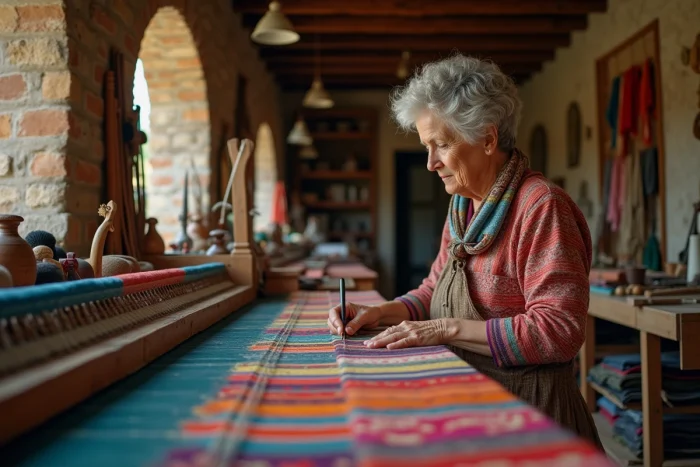
Nothing is left to chance in these workshops. Unwinding the silk cocoon requires delicate mastery; assembling, twisting, and braiding the silk threads demands rigor and meticulousness. Some bet on wild silk, sourced from non-domesticated worms: they obtain an irregular thread, with a distinctly different texture, giving each piece a soul unlike that of classic silk.
the production of luxury fabrics is now transforming into a laboratory where traditions and innovations respond to each other. Major designers seek both the purity of silk and its combination with other rare materials, from cashmere to vicuña wool or, for exceptional pieces, gold thread. Each fabric thus stands out for the uniqueness of its material and the signature of a pronounced craftsmanship.
From hand-woven Indian saris to fabrics reserved for haute couture houses, silk retains its special status: it traces the journey of materials as well as techniques, perpetuating a memory while adapting to contemporary desires. In every era, this thread maintains its vitality and continues to attract both discerning enthusiasts and creators in search of inspiration.
Why does silk fascinate the fashion world so much?
The charm is immediate: to the touch, silk astonishes with its lightness. Its unique way of playing with light, reflecting a thousand glimmers with every movement, directly results from the prismatic structure of the fiber. This singular shine is not a matter of chance.
Silk satin embodies the essence of this refinement: a fluid and soft fabric that adorns both ceremonial dresses and the simplest blouses. Yet, silk is never where one expects it: it can also retain warmth in winter and keep cool in summer, offering subtle comfort in every season.
Here are the distinctive properties that place silk so high in the esteem of couturiers:
- Strong yet fine: beneath its fragile appearance, silk is as solid as the best natural fibers.
- Versatile: from vibrant satins to airy muslins, it accommodates all weaves and whims.
- Complementarity with other fibers: when combined with wool, linen, or cashmere, it creates fabrics with an incomparable touch and flexibility.
In fashion, it remains the symbol of refinement. Its fluidity, the softness of its touch, and the way it enhances every shade make it the natural ally of the greatest designers. Season after season, silk transcends trends and refuses to fade away. Few fibers possess this power of attraction.

Silk, a driving force for inspiring experiences and creations
For a long time, silk has served as a common thread between eras and cultures. From ancestral techniques to the know-how of Parisian workshops, it remains one of designers’ favorite playgrounds. Its versatility stimulates all fantasies: from textured wild silks to scarves as light as they are precious, from simple kimonos to spectacular drapes, in every use, silk brings its own signature.
Throughout the seasons, it finds its place in all collections while satin illuminates the silhouette and silks with imperfect reliefs appeal to lovers of authenticity. In the home, it appears as delicate linens or accessories, bringing comfort and elegance even into the intimacy of everyday life.
Above all, silk marks life moments. Behind every scarf weathered by time, every dress reserved for special occasions, or that pajama one only dares to wear during exceptional nights, there is a story woven between the material and its owners. Durability, sensuality, and transmission: silk transcends fashion. It continues to inspire collectors as well as evening visitors. Its thread, vibrant across the ages, is far from finished weaving new tales.