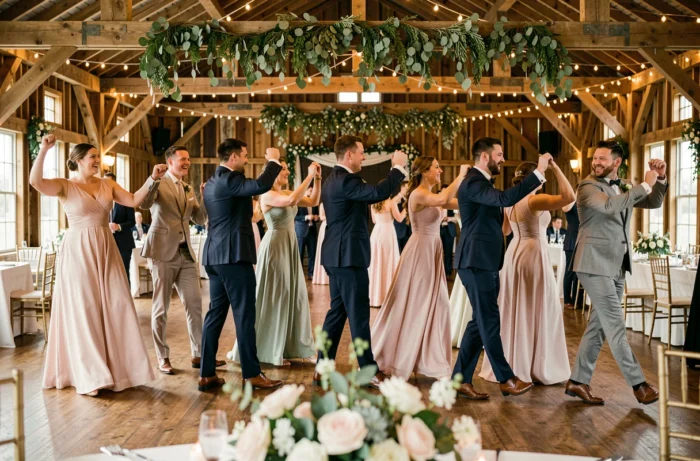
The Madison is based on a rhythmic structure in 4/4 with codified steps that everyone can reproduce without prior learning. This line dance, born in the United States in the late 1950s, works at a tempo between 120 and 140 BPM. For a wedding, the choice of the song determines both the energy of the dance floor and the guests’ ability to follow the choreography.
Tempo and rhythmic structure of the Madison: what makes a song work
A song compatible with the Madison must adhere to a specific technical constraint: a steady tempo between 120 and 140 BPM with a strong beat on each beat. The steps of the Madison (step right, step left, back, forward) follow blocks of eight beats. If the song changes speed or breaks its rhythm in the middle of a verse, the group’s synchronization is lost.
Pop, rock, or soul songs that have a very identifiable chorus and a stable rhythmic section provide the best foundation. The decisive criterion is not the musical genre but the regularity of the beat and the clarity of the structure.
To explore modern music for dancing the Madison, you must first check this tempo parameter before considering the style or popularity of the song.
Selection of modern songs suitable for the Madison at weddings
The following songs share a common point: a strong rhythm, a unifying chorus, and an energy that encourages guests to hit the dance floor without hesitation. Rather than reproducing a generic playlist, here are categories of songs that work according to the desired atmosphere.
Contemporary pop and soul
Regular groove songs from recent pop or soul adapt very well to the Madison. The repetitive chorus allows guests to navigate the choreography. Songs with a prominent bass line and brass add an immediate festive dimension.
- Bruno Mars’ songs (Uptown Funk, 24K Magic) offer a stable tempo and a disco-funk energy that fits perfectly with the Madison steps
- Tracks by Pharrell Williams or Justin Timberlake (Happy, Can’t Stop the Feeling) work thanks to their steady pulse and universally recognizable character
- Soul covers of pop classics, played by a live band, allow for adjusting the exact tempo to the dancers’ level
Rock and country-pop
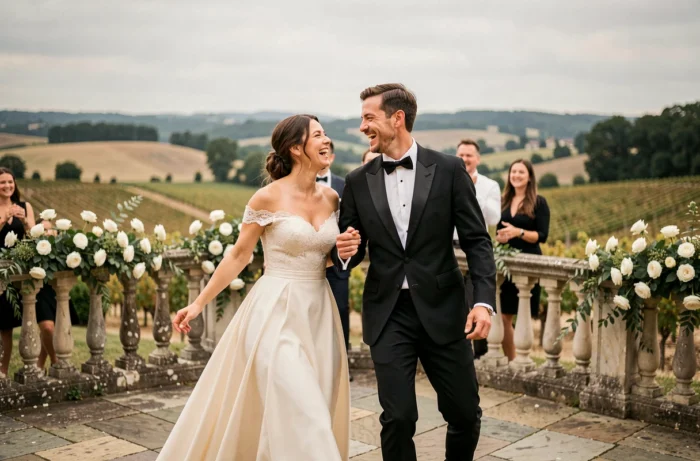
The country-pop crossover brings a different, warmer color. Songs like those by Shania Twain or rock covers of 1960s standards maintain a square beat ideal for the Madison. A rock song with a constant tempo is a great substitute for a worn-out disco track from years of party play.
The rock of the 1960s remains the historical root of the Madison. Returning to guitar-bass-drums sounds with modern arrangements creates a bridge between generations on the dance floor.
Live band or DJ: what format for the Madison at wedding receptions
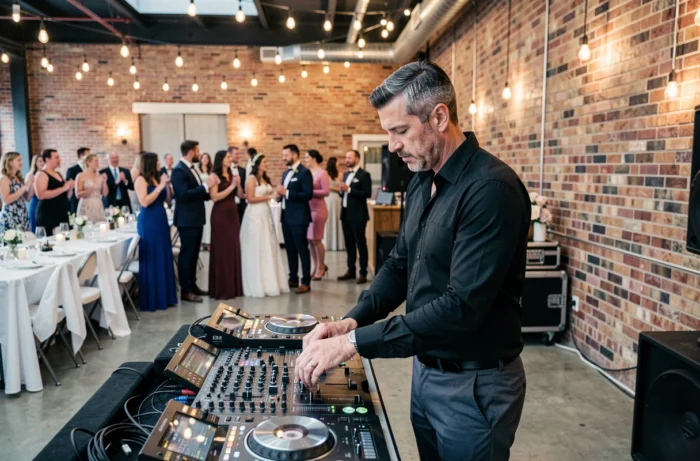
The recent trend in wedding music entertainment combines a live band for the first part of the evening and a DJ for the rest of the night. For the Madison, this combination has a concrete advantage.
A band can play the chosen song for the Madison while adjusting the tempo live. If guests lose interest, the musician slows down slightly. If the energy rises, they speed up. This adaptability is impossible with a fixed playlist.
The DJ then takes over with remixed versions or transitions that extend the collective momentum. A Madison medley (three songs played in a row without pause) keeps the dance floor filled longer than a single isolated track.
Rearranged covers: an underutilized lever
Wedding bands and orchestras now offer rearranged covers of pop, rock, or soul songs. The principle: keep the familiar melody of the original song while giving it a more danceable live arrangement. A song by Dua Lipa or The Weeknd, played with brass and a Madison tempo, becomes a moment of surprise for guests.
The rearranged cover retains the familiarity of the song while adding live energy. This format works particularly well for the Madison because guests recognize the song but discover a version that encourages them to dance differently.
Building the musical progression around the Madison
Placing the Madison at the right moment in the evening changes its impact. The most effective wedding programs build an emotional progression: a gentle start after the meal, a gradual increase in energy, and a dancing peak in the middle of the evening.
The Madison is ideally placed at the beginning of the dancing phase. It is a collective, codified dance that does not require a partner. It breaks the ice before the free dance songs. Scheduling the Madison too late in the evening reduces its unifying effect, as the guests who are less comfortable with dancing will have already left the floor.
The sequence that works: a first ambient song to draw guests to the dance floor, then the Madison as the second or third track. Then, transition directly to a disco or funk song with a similar tempo to keep the group together.
- Before the Madison: a slow or mid-tempo song that gathers without intimidating (Motown, soft French variety)
- The Madison itself: a modern song with a strong tempo, chosen for its rhythmic clarity
- After the Madison: a funk, disco, or dance-pop transition that capitalizes on the collective momentum
- Avoid cutting the energy with a slow immediately after, which empties the floor
The choice of the song for the Madison is not just a matter of taste. It is a technical choice (tempo, rhythmic regularity) as much as an ambient choice (musical genre, familiarity of the song).
Modern songs with a stable beat and recognizable chorus fill the dance floor more effectively than classic Madison repertoire songs, which are often unknown to younger guests. Testing the song in advance with the DJ or live band remains the most reliable method to avoid an empty dance floor on the big day.