
Classifying light recipes by categories requires choosing a sorting criterion. The most common, the culinary family (starter, main course, dessert), says nothing about the nutritional density or the actual satiety of the dish. Recent guidelines from ANSES prioritize the composition of the plate (vegetables, legumes, whole grains, oils rich in omega-3) rather than just calorie reduction. It is this framework that structures the classification proposed here.
Categories of light recipes sorted by plate composition
Rather than separating soups, salads, and gratins, a classification by nutritional dominance allows you to identify what is missing from a weekly menu. The table below distinguishes four families of light recipes according to their main base.
| Dominant category | Recipe examples | Main nutritional benefit | Perceived satiety |
|---|---|---|---|
| Raw or cooked vegetables | Vegetable tian, grated carrot salad, zucchini velouté | Fiber, high volume for few calories | Moderate (to be complemented with a protein source) |
| Legumes | Green lentil salad, chickpea curry, red bean soup | Plant proteins, iron, soluble fiber | High |
| Whole grains | Quinoa salad, whole grain rice stir-fried with vegetables, bulgur tabbouleh | Complex carbohydrates, magnesium | High |
| Lean proteins (poultry, fish, egg) | Herb-grilled chicken, cod en papillote, vegetable omelet | Complete proteins, low in saturated fats | Very high |
The most filling recipes combine at least two of these categories. A vegetable gratin alone, for example, generates shorter satiety than a vegetable gratin paired with coral lentils.
To explore a wide range of dishes organized according to this logic, the index of the site Les Recettes Légères de Chrissy groups light recipes classified by dominant ingredient, making it easier to plan balanced meals throughout the week.
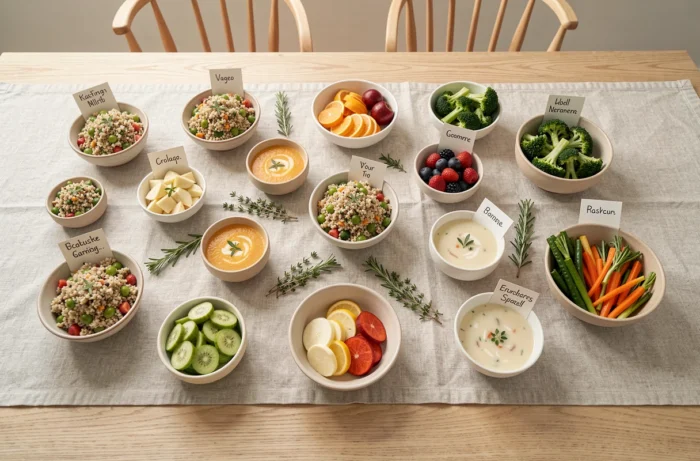
Legumes and whole grains in light recipes: an underutilized satiety lever
The selections of light recipes found online heavily favor vegetables and salads. Legumes rarely appear as a central ingredient. This absence poses a satiety problem: a light meal that does not satisfy leads to snacking in the hours that follow.
Lentils, chickpeas, and dried beans provide plant proteins and soluble fibers that slow digestion. Incorporated into a warm salad or a velouté, they transform a dish perceived as a starter into a complete meal.
Combining legumes and vegetables in the same dish
The simplest combination remains the composed salad: quinoa or bulgur as a base, legumes for structure, raw vegetables for crunch. This type of recipe can be prepared in batch cooking on Sunday and adapted for several meals throughout the week.
- Green lentil salad with grated raw beet and feta: the lentil provides satiety, the beet adds volume, and the feta gives a touch of indulgence without excess fat
- Light chickpea and spinach curry: the spices (cumin, turmeric, coriander) enhance the dish without adding cream, and the chickpeas keep you full until the next meal
- White bean and leek soup: an autumn dish that advantageously replaces the classic velouté, with a denser texture and significantly higher protein content
Legumes represent the most neglected category in selections of light recipes, even though they precisely address the most common problem of this type of cooking: hunger returning too quickly.
Light evening recipes: why the evening meal concentrates mistakes
The majority of research around light recipes focuses on dinner. The most common reflex is to eliminate starches in the evening. In practice, removing complex carbohydrates from dinner increases the risk of nighttime cravings.
ANSES recommendations do not distinguish meals by time of day. They emphasize overall balance: ample vegetables, varied proteins, limiting meat other than poultry and processed meats, oils rich in omega-3 (rapeseed, walnuts, flaxseed).
Creating a light dinner without sacrificing starches
The key lies in portion control. A moderate serving of whole grain rice or whole grain pasta, accompanied by a greater volume of vegetables, results in a light meal without frustration. The zucchini gratin with whole grain rice is a good example: the rice absorbs the water from the zucchini, the texture remains tender, and a reasonable amount of grated cheese adds flavor without weighing down the dish.
An effective light dinner contains one-third vegetables, one-third whole grains, and one-third lean proteins. This simple distribution avoids complex calculations and adapts to any recipe.
Nutri-Score and homemade recipes: adapting the framework to your own dishes
The new Nutri-Score, updated according to information from Quitoque, does not apply directly to homemade dishes. It concerns packaged products sold in stores. However, its scoring criteria provide a useful framework for evaluating your own recipes.
The Nutri-Score penalizes excess sugar, salt, saturated fats, and low fiber content. Applying these same criteria to a homemade recipe involves asking four questions before cooking:
- Does the recipe contain a source of fiber (vegetables, legumes, whole grains)?
- Can the added salt be reduced in favor of herbs or spices?
- Are the fats used predominantly unsaturated (olive oil, rapeseed oil) rather than saturated (butter, cream)?
- Is the added sugar limited to what is strictly necessary, especially in light desserts?
Four Nutri-Score criteria are sufficient to evaluate a homemade recipe without needing to weigh each ingredient to the exact gram. This approach transforms the classification by categories into a quick decision-making tool for the week.
Light recipes benefit from being thought of as a system rather than a collection of isolated dishes. A classification by plate composition, combined with a quick check of the four Nutri-Score criteria, provides a sufficient framework to vary meals without repeating the same salads each week.