
Jannik Sinner was born on August 16, 2001, in San Candido, a village nestled in the Dolomites, a few kilometers from the Austrian border. Before becoming the world number one in tennis, he grew up in an environment where skiing, mountains, and Italian-German bilingualism shaped daily life. Understanding his family roots is key to grasping why this champion stands out as much for his calmness as for his game.
South Tyrol: A German-speaking culture at the heart of Italy
South Tyrol (or Alto Adige) is an autonomous Italian province where the majority of the population speaks German on a daily basis. Jannik Sinner grew up in this bilingual context, with German at home and Italian at school or on the courts.
This dual culture is not incidental. Several analyses published since his rise to the top of the ATP directly link his German-speaking roots to his disciplined and reserved temperament. On the circuit, his attitude contrasts with the more expansive style often associated with Italian athletes. The mountainous, rural setting, where the seasons dictate life, has evidently instilled in him a form of sobriety that is reflected in his management of points under pressure.
To better understand the origins of Jannik Sinner’s parents, one must look back to this alpine environment where physical labor and discretion are values passed down without words.
Johann and Siglinde Sinner: Mountain hospitality professions
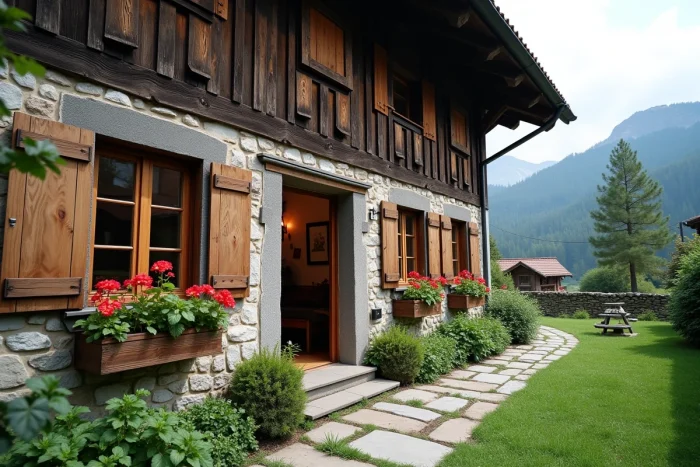
Johann Sinner is a cook. Siglinde Sinner worked as a waitress. They both met in a mountain hut called Talschlüsshutte Hut, a typical establishment in the Dolomites. This detail says a lot: the Sinner family comes from a world of seasonal labor and service, far from the realm of professional sports.
Why does this professional background of the parents matter so much? Because it has defined Jannik’s relationship with work and money. In an interview after his first Grand Slam title at the Australian Open in 2024, he expressed a wish that everyone could have parents like his, highlighting their role in his personal development.
Johann sometimes accompanies his son on the circuit as a personal chef, allowing them to spend time together despite constant travel. This choice reveals a family that seeks closeness through concrete gestures rather than media presence.
Staying in the village: A deliberate life choice in the face of fame
Here is the most revealing point. While many champion families move near tennis academies or into big cities, Sinner’s parents have refused to change their lives despite his rise. They continue to work in their restaurant-hut in the Dolomites.
This is not a coincidence or a lack of means. It is a conscious decision to preserve values of simplicity. Johann and Siglinde do not attend their son’s matches as often as they would like, for a touching reason: they prefer to maintain their ordinary life rather than shift into the orbit of professional tennis.
This family stability produces a measurable effect on the court. Sinner’s coaches now consider his emotional stability a real competitive advantage in the new generation of tennis. His ability to handle crisis moments, to remain unflappable after conceding a break, is said to be directly linked to a pressure-free upbringing and a family environment deliberately distanced from the spotlight.
What other Italian players and coaches say about it
In reports aired around Roland-Garros and Wimbledon, more experienced Italian players and federation coaches have highlighted the atypical nature of this family setup. Most high-level tennis families restructure their daily lives around the child’s career. The Sinners have done the opposite.
This approach has also allowed Jannik to develop a form of autonomy very early on. At 13, he left skiing (he was the national vice-champion in giant slalom) to focus on tennis, and his parents gave him total freedom to choose his own path.

From skiing to tennis: How family values guided the transition
You may wonder why a kid from the Dolomites, destined for alpine skiing, switched to tennis in his teenage years? The answer partly lies in the educational framework set by Johann and Siglinde.
Their central principle: never impose a path. When Jannik, at 13, expressed his desire to leave skiing for a tennis academy far from home, his parents did not hinder the decision. They also did not abandon everything to follow him. They trusted him.
This trust produced three concrete results:
- A work ethic inherited from the hospitality industry: Sinner often repeats that his relationship with effort comes from what he observed in his parents, up at dawn to serve the hut’s customers
- A capacity to live independently and structure himself at a very young age, a rare quality among teenagers entering the professional circuit
- A detachment from fame, regularly noted by those around him, which keeps his focus on the game rather than on image
Jannik Sinner himself summarized this philosophy after a tournament: his parents and friends know who he really is, and that is what matters most to him. Fame has not changed his relationship with his family, and that is precisely what makes his journey unique in today’s tennis.
The first Italian player to reach the number one spot in the world in 2024 is not the product of a champion-making machine. He comes from a mountain hut where soup is served to hikers. This origin, far from being a handicap, has transformed into a foundation.